Driveways are one of those elements of a property that tend to be ignored until they become impossible to ignore. Cracks spread across the surface, sections heave up or sink down from freeze-thaw activity, edges crumble away, and eventually the surface that was once functional becomes a patchwork of deterioration. At some point, repair is no longer the right answer. What is needed is complete demolition and replacement.
In Flint, Michigan, Driveway Demolition Flint is a common service driven by the realities of Michigan’s climate and the age of much of the city’s housing stock. Understanding what driveway demolition actually involves, what precedes it, and what follows helps property owners plan and execute this project effectively.
When Demolition Becomes the Right Choice
Not every cracked or damaged driveway requires demolition. The decision between repair and full replacement hinges on the nature and extent of the damage.
Surface-level damage such as minor cracks, shallow surface scaling, or small areas of spalling can often be addressed through crack filling, patching, or resurfacing. If the underlying base is still solid and the damage is limited to the top layer, full demolition is not necessary.
Structural failure where the base beneath the surface has deteriorated, where large sections have heaved or sunk significantly, where alligator cracking (a network of interconnected cracks resembling the scales of an alligator hide) covers substantial portions of the surface, or where the driveway has been repeatedly patched without lasting improvement indicates that the entire system has failed. In these cases, demolishing the old surface and rebuilding from the base up is the only lasting solution.
For Flint-area driveways, base failure is often the underlying issue. Freeze-thaw cycles over many Michigan winters, combined with clay soils that expand when wet, create conditions that eventually undermine even well-installed driveways. A driveway that has reached this point cannot be saved through surface repair alone.
Types of Driveway Material and How Demolition Differs
Driveways in Flint are most commonly surfaced with one of three materials, and the demolition approach varies by material type.
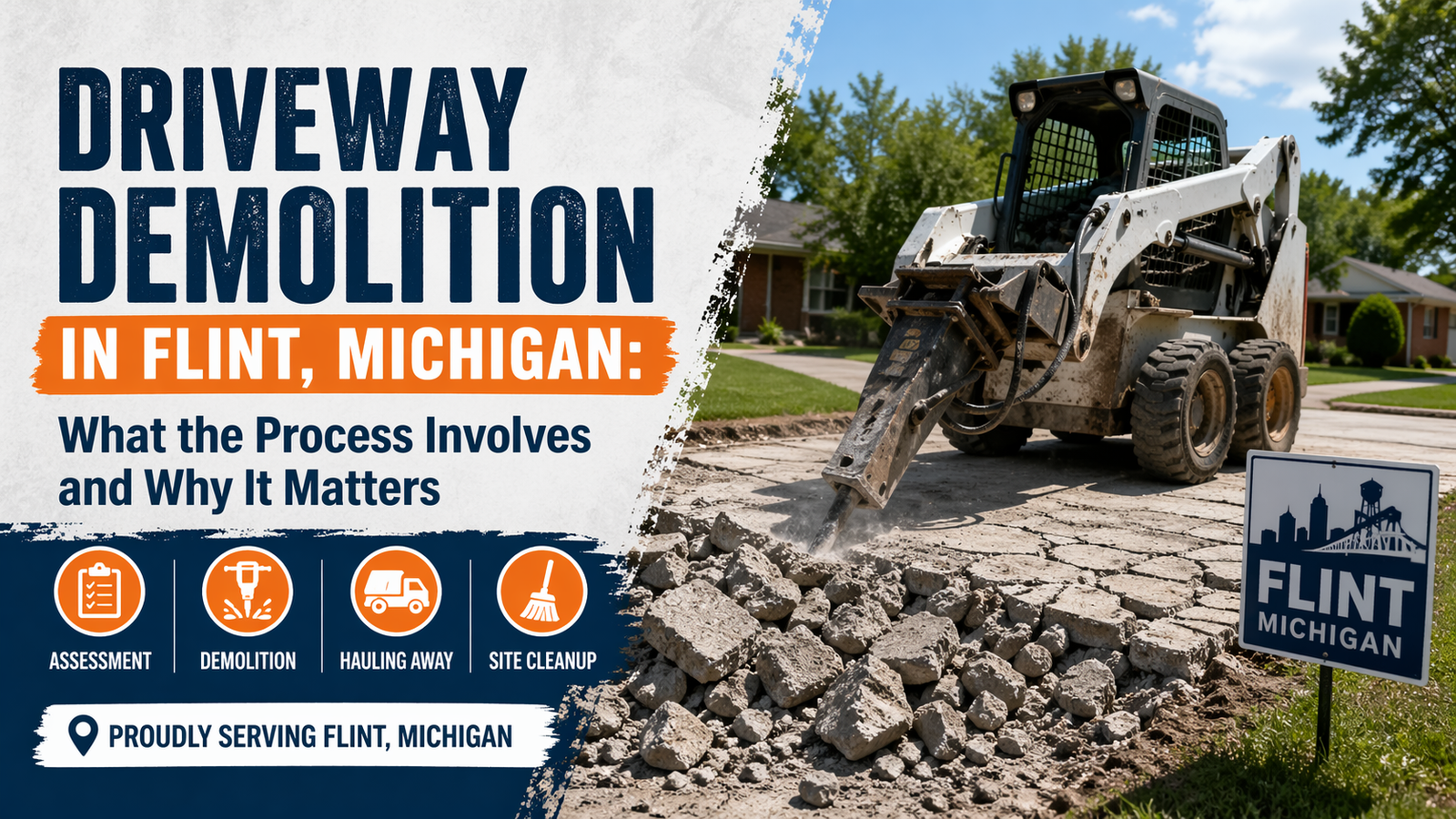
Asphalt Demolition Asphalt driveways are demolished using several methods. Cold milling machines can grind the asphalt surface to a controlled depth, useful when the milled material will be recycled and the base below is being retained. Excavators equipped with hydraulic breakers or bucket teeth can break up thicker asphalt sections. Jackhammers and skid steers with breaker attachments are used in tighter spaces where larger equipment cannot manoeuvre effectively. Asphalt is highly recyclable the demolished material is typically collected and sent to an asphalt plant where it is processed back into new asphalt mix.
Concrete Demolition Concrete driveways require more force to demolish than asphalt due to their greater rigidity and strength. Hydraulic breakers mounted on excavators are the primary tool for concrete demolition. Wire mesh or rebar reinforcement embedded in older concrete must be cut and separated from the broken material. Concrete demolition generates heavier, bulkier debris than asphalt, which affects removal logistics. Like asphalt, concrete can be recycled crushed concrete aggregate is used in road base and other construction applications.
Gravel Driveway Removal Though gravel driveways do not require the breaking and demolition of a rigid surface, removing accumulated gravel and the compacted base material beneath it still involves excavation equipment and hauling. The area must be properly excavated to the correct depth before a new surface is installed.
The Driveway Demolition Process Step by Step
A professional driveway demolition project follows a logical sequence:
Initial Assessment Before any equipment arrives, the existing driveway is evaluated. The material type, thickness, extent of damage, and condition of the base beneath are assessed. Underground utilities are identified through the MISS DIG 811 system this step is mandatory before any excavation or demolition in Michigan.
Site Preparation The work area is set up to protect adjacent surfaces, landscaping, and structures. Depending on the site layout, this may involve temporarily blocking access to the garage or adjusting drainage to manage water during the work.
Breaking and Demolition The existing driveway surface is broken up using appropriate equipment. Material is broken into manageable pieces suitable for loading and removal.
Removal and Disposal Demolished material is loaded into trucks or on-site containers and hauled to appropriate recycling or disposal facilities. Asphalt and concrete are directed to recycling facilities wherever possible.
Base Evaluation With the old surface removed, the base material and subgrade beneath are evaluated. If the base is salvageable, it may be graded and compacted. If it has deteriorated, it must be removed and replaced before the new surface is installed.
Site Readiness for New Installation Once the demolition debris is cleared and the base is evaluated and prepared, the site is ready for the new driveway installation to begin.
Permit Requirements in Flint
Driveway demolition and replacement in Flint, Michigan may require permits depending on the scope of the project and whether the work affects the public right-of-way, including the portion of the driveway apron that connects the private driveway to the public street. Property owners should verify permit requirements with the City of Flint’s Building Safety Inspection & Permits office before work begins. Reputable demolition and excavation contractors are familiar with local permit requirements and can assist property owners in understanding what is needed.
Environmental Considerations in Driveway Demolition
Demolition generates dust, particularly when breaking concrete. In residential settings, dust control measures such as water misting during demolition are used to limit the spread of dust to neighbouring properties and public spaces.
In Flint, where some older properties may have structures or driveways dating back to periods when different materials and additives were used in construction, there is occasionally a concern about the presence of hazardous materials. While residential driveways are unlikely to contain asbestos (which was more commonly associated with building materials inside structures), any concerns about the material composition of the existing surface can be addressed through pre-demolition testing.
What Happens to the Demolished Material
One of the environmentally positive aspects of driveway demolition is the high recyclability of the primary materials. Asphalt demolition material is routinely processed back into new asphalt mixes, with recycled asphalt pavement (RAP) content in many modern asphalt formulations exceeding 20 to 30 percent. Crushed concrete is used as aggregate in road base applications, reducing demand for quarried stone. Responsible demolition contractors in Flint direct demolished driveway material to appropriate recycling facilities rather than disposal in landfills.
Integrating Demolition with New Driveway Installation
The most streamlined outcomes come when the same contractor performing the demolition also plans and executes the new driveway installation. This eliminates handoff delays, ensures that the base preparation is done to the specifications of the new surface material, and gives the property owner a single point of accountability for the entire project.
In Flint, where contractor availability can vary with the season asphalt paving season runs roughly from spring through mid-autumn, depending on temperature conditions planning demolition and new installation as a single integrated project is advisable. Attempting to demolish in one season and replace in the next creates a period when the property is without a functional driveway and the exposed base is vulnerable to the elements.
Conclusion
Driveway demolition in Flint, Michigan is a practical, frequently necessary step in restoring a property’s function and appearance after Michigan winters and the passage of time have taken their toll on an aging surface. Understanding the process from the initial decision between repair and full demolition, through material removal and base evaluation, to preparation for new installation helps property owners approach this project with confidence. Professional demolition contractors bring the equipment, knowledge, and local experience needed to perform this work safely, efficiently, and with minimal disruption to the surrounding property.